Scenario guide
The Death Smell That Won't Go Away
You did everything you were told. The house was cleaned, or aired, or treated, and for a while it seemed fine. Then a warm afternoon arrived, someone opened the door, and there it was again. This page is about that specific frustration: why a death smell returns, where it is hiding when it does, and what finally ends it.
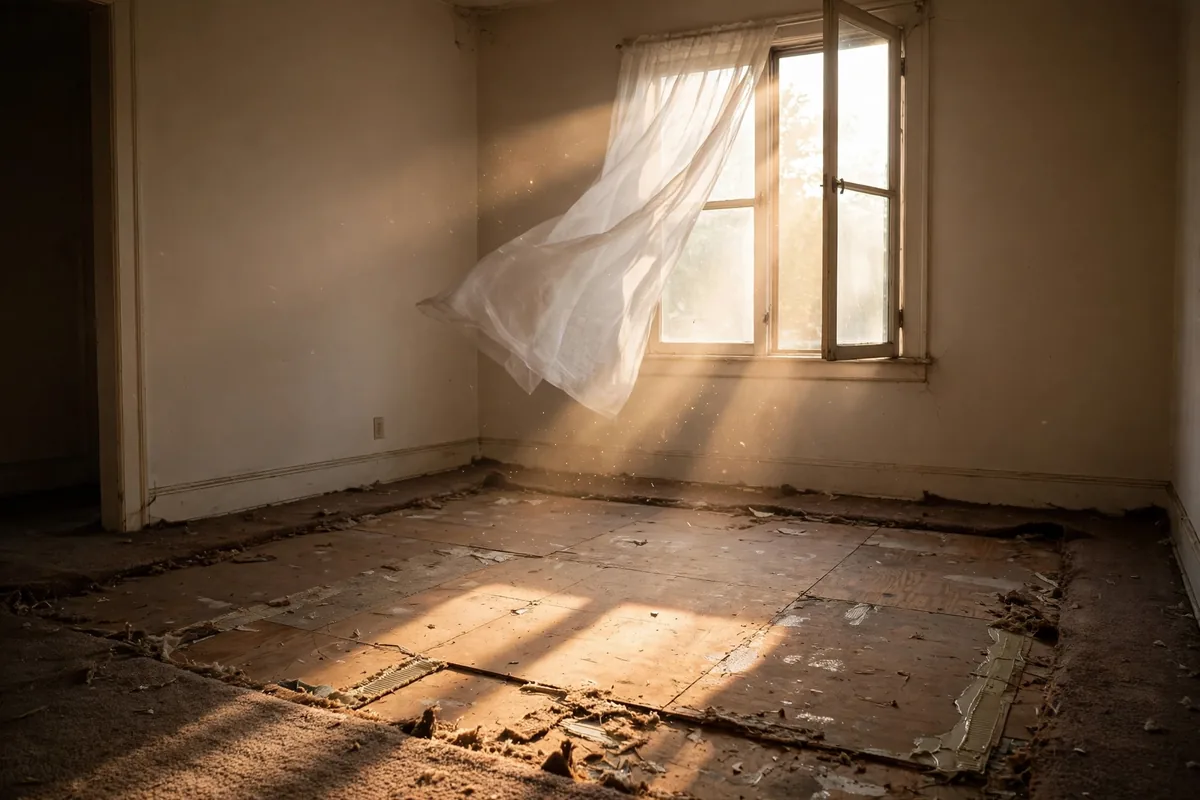
A death smell that will not go away is not in the air; it is in material that never got removed. Decomposition compounds soak into carpet padding, subfloor, drywall and insulation, and they keep releasing, faster whenever the room warms. Airing out, sprays and ozone clear the air for days at most. The smell ends when the full reservoir is found, removed or sealed; it is never truly permanent.
The smell is a place, not an event
Start with the physical picture, because everything else follows from it. During decomposition, fluids carry odor compounds, putrescine, cadaverine and sulfur compounds among them, out of the body and into whatever is porous nearby: carpet and the padding beneath it, mattress foam, upholstery, wood flooring, subfloor, drywall, insulation, even concrete. Those materials become a reservoir. They hold the compounds and release them slowly, for months if nothing changes. This is why the language matters: a smell that "won't go away" is almost never a cleaning failure in the air. It is a piece of the building still doing what it has been doing since the death. Until the reservoir is dealt with, every other measure is a pause button. If you are earlier in this process and still choosing how the odor gets removed the first time, our guide on removing death odor from a house sets out the working sequence; this page is for when that sequence apparently happened and the smell outlived it.
The pattern everyone describes, and what it means
Listen to how families describe a returning smell and you hear the same three beats. It was gone, or nearly gone, after the cleanup or the airing. It came back on a warm day, or when the heating ran, or when the room sat closed. And it is strongest in one place: near the floor, by one wall, at the spot itself. Each beat is diagnostic. Gone then back means something is releasing in cycles rather than sitting in the air. Warmth as the trigger means stored compounds in material, because heat speeds their release. One strong place means the reservoir has an address. A smell that behaves this way is not mysterious and it is not your imagination, which families also quietly wonder. It is a map, and a competent diagnosis follows it.
Where it hides: the usual reservoirs
- Carpet padding. The commonest miss. Carpet gets cleaned or replaced while the padding that absorbed the most stays underneath, out of sight and still loaded.
- Subfloor edges and seams. Fluids pool and wick along seams and at the room's edges, under baseboards, where a surface clean never reaches.
- The bottom of drywall and insulation. Drywall wicks fluid upward from the floor line; the visible wall can look untouched while the lower section and the insulation behind it hold the source.
- Soft furniture left in the room. A mattress is the obvious one, but upholstered chairs and sofas near the scene absorb compounds through the air alone over days.
- Ductwork. Where the heating or cooling ran during the event or the cleanup, ducts can hold and redistribute odor to rooms that were never involved.
What does not end it, however often it is repeated
Repetition is the trap. Airing out lowers the airborne level and nothing else; the reservoir refills the room between airings. Fragrance covers for hours. Ozone and fogging genuinely break down compounds in air and on exposed surfaces, and professionals use both, but neither reaches through a floor into soaked padding, and neither stops material from producing more. Sealing is the subtlest failure: an odor blocking primer over a live source seals nothing, because the source keeps generating behind the film. Every one of these has a place in the sequence that works. Used alone, in place of finding the reservoir, each produces the same sentence a month later: it came back.
Diagnosis before treatment: how a returning smell gets solved
- Test the room the hard way. Close it, warm it, give it time, and check with a nose at floor level. A job that only passes on a cool morning has not passed.
- Localize. Strongest at the floor suggests padding or subfloor; at one wall, drywall and insulation; everywhere at once when the system runs, ductwork.
- Open the minimum necessary. A lifted carpet corner, a removed baseboard section, an inspection cut: small openings that confirm which reservoir is live before any large removal.
- Remove or seal the actual source. Saturated material comes out as regulated waste; sound material that cannot be removed gets disinfected and sealed with a proper odor blocking primer, as the last step.
- Retest warm. The same closed, warm room test, days later. That result, not the day of treatment, is the verdict.
The landlord version of this problem
This problem has a second victim: the next tenant. A unit can pass a landlord's visual inspection and a cool day viewing, get re-let, and fail on the first hot afternoon with a new tenant inside, which converts an odor problem into a lease dispute. Odor travels through shared ventilation in multi unit buildings, so the complaint may surface next door rather than in the unit itself. The protection is the same diagnosis, done before re-letting rather than after a complaint, plus the documentation that proves it was done. Whether the deeper question is living in the house yourself, our guide on staying in the house after a death covers the safety side of staying, room by room.
When to stop diagnosing and call
If the smell has survived one full cleanup and one warm week, further home treatment is spending money on the pause button. The diagnosis above is inspection work, and under unattended death cleanup crews do it as a defined job: find the reservoir, remove or seal it, and test the result warm. It is a smaller job than the original cleanup in most cases, because most of the house was done right the first time. What it should never be is a second full price for the same room. Ask for the diagnosis first, in writing, and the removal scope second.
Questions families ask us
The cleanup was done weeks ago. Why does the smell keep coming back?
Because odor lives in materials, not in air. If any soaked material was left in place, carpet padding, a subfloor section, the bottom of a wall, it keeps releasing odor compounds, and it releases them faster when the room warms up. Deodorizing treatments clear the air for a while, then the reservoir refills it. Coming back is the signature of a source that was treated around, not removed.
Does a returning smell mean the house is still unsafe?
Not always, and the two questions are separate. A space can test clean for pathogens and still hold odor compounds in porous material; odor is a quality failure, not automatically a health one. But a returning smell after a cleanup is worth taking seriously, because the same hidden material that holds odor is exactly where contamination hides too. The honest check is inspection and testing, not a nose alone.
Can a smell become permanent?
No. Odor compounds sit in specific materials, and materials can be removed or sealed. There is no case where a death odor is truly permanent; there are cases where nobody has yet found or removed the full extent of what absorbed it. The limit is diagnostic, not chemical: find all of the reservoir and the problem ends.
We aired the house out and it smelled fine. Then summer came. What happened?
Temperature is the tell. Materials release absorbed compounds faster as they warm, so a house can pass a cool weather check and fail its first warm week. Winter airing lowers the airborne level without touching what is stored in carpet, padding and wood. The first hot spell is simply the building reporting what was still in it.
Is it the drains or the heating system?
It can be either, and both get blamed unfairly and correctly by turns. Odor travels through shared ductwork, so a system can distribute a smell whose source is one room. Dried drain traps can also let sewer gas in, which is a different smell with a different fix. A proper diagnosis checks the room materials first, then the ducts, then the traps, in that order.
What should I ask the company that did the original cleanup?
Ask what was removed, what was sealed, and what the testing showed, and ask them to come back and inspect the specific place the smell is strongest. Reputable crews document their scope; if a missed pocket of material is found, it should be named plainly. If the original company will not re-inspect, an independent crew can diagnose it without redoing the whole job.
One call starts the process
You do not have to face the scene, the smell or the paperwork alone. Call and we will connect you with a trained, verified local cleanup crew, day or night.
Call NowOpen 24 hours, every day, nationwide.