Guide
Can You Clean Up a Biohazard Yourself?
It is a fair question, usually asked at 2am with a phone in one hand: can you clean up a biohazard yourself, and save the cost of a crew? This guide answers honestly. Sometimes yes, for the smallest spills. For most of what this site deals with, no, and the reasons are more practical than dramatic: protection, chemistry, and a waste problem most people cannot solve legally on their own.
For a few drops of your own blood on a hard floor, yes: gloves, a household disinfectant and care are enough. For anything soaked into materials, anyone else's blood, or any scene involving a death, the honest answer is no. Safe cleanup needs protective equipment, rated disinfectants, surface testing and a lawful route for the waste, and the waste is the part a homeowner usually cannot solve legally.
The short answer: where the line sits
A few drops of your own blood on a hard floor after a kitchen cut: clean it with gloves and a household disinfectant, and you have done enough. The line is crossed when blood or fluids are someone else's, when they have soaked into anything soft, when the spill is more than a few drops, or when a death is involved. Past that line, the job stops being cleaning and becomes regulated work, and each section below explains one reason why.
What doing it yourself actually involves
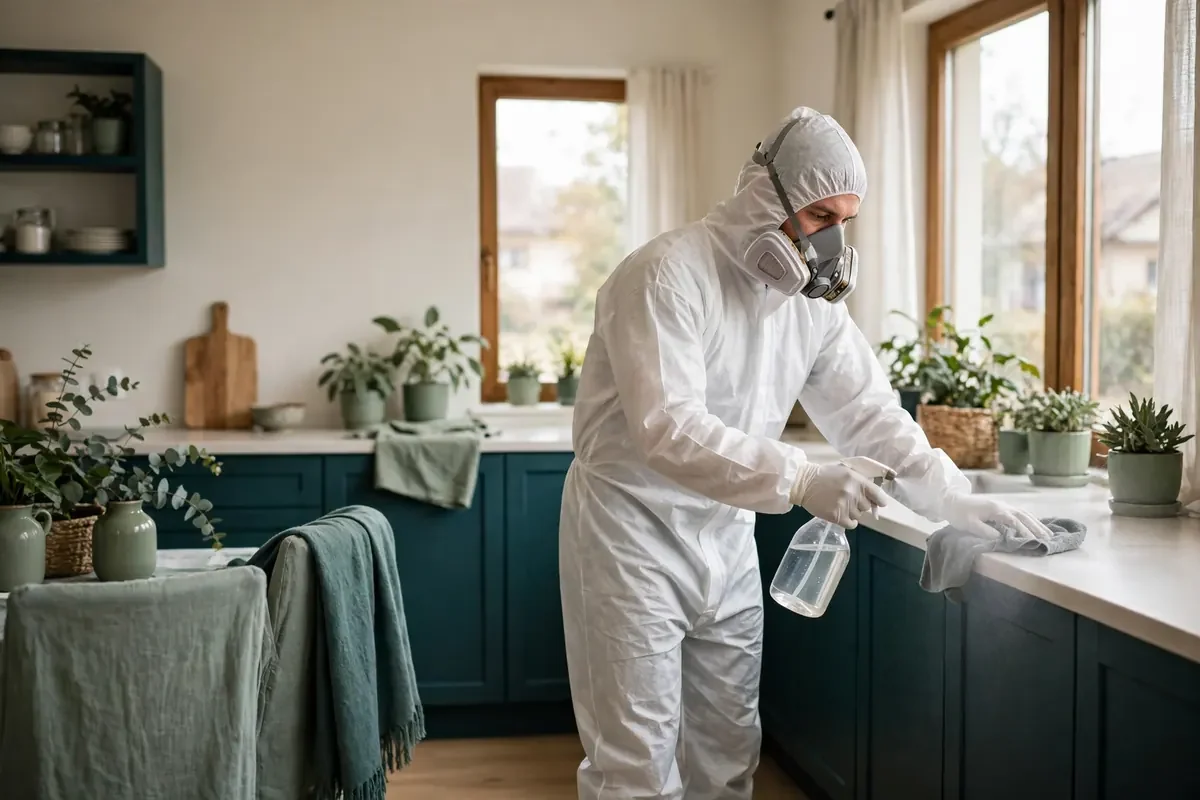
A professional cleanup is a sequence, and every step exists because the step before it is not enough on its own. Protective equipment goes on first: gloves, eye protection, a respirator, and usually a suit, because the risk travels through skin, eyes and air, not just touch. The area is contained so nothing tracks into clean rooms. Material that fluids have soaked, carpet padding, mattress foam, upholstery, is cut out and removed, because it cannot be disinfected in place. Hard surfaces are washed, then disinfected with products rated for bloodborne pathogens, left wet for the contact time the label demands. Then the disinfection is tested on the surface itself. Finally, everything removed leaves as regulated waste, with paperwork. A DIY version has to match every one of those steps to be equivalent, and most home attempts manage two of them.
The risk is infection, not mess
Blood and bodily fluids can carry hepatitis B, hepatitis C and HIV, along with bacterial infections that have nothing exotic about them. Some of these viruses stay infectious in dried blood for days, on a surface that looks harmless. The risk routes are ordinary: a cut on your own hand, a splash near your eyes, residue on a shoe walked through the house, a sharp object hidden in bedding. Professional crews manage that risk with training, vaccination offers, protective equipment and a written exposure plan, the framework the federal bloodborne pathogens standard sets for anyone whose work involves blood. A homeowner has none of that structure, and usually does not know which parts they are missing.
Why household cleaners are not enough
Household bleach and sprays are not useless, but they fail this job in three quiet ways. First, disinfection is exact: the product, the dilution and the contact time all have to be right, and a surface wiped dry in ten seconds has not been disinfected however strong it smelled. Second, fluids travel. Blood wicks through carpet into padding, through grout into the bed under tiles, through mattress ticking into foam. Wiping the top leaves the reservoir underneath, which is also where odor comes from later. Third, there is no test at the end. A room that looks clean and a room that is clean are different things, and only surface testing tells you which one you have.
The waste problem nobody warns you about
This is the step that stops most determined DIY attempts, and it is a legal problem, not a cleaning one. Everything soaked, plus the gloves, cloths and protective gear you used, becomes regulated medical waste the moment it comes off the scene. In most jurisdictions that waste cannot go into household trash, cannot ride in a family car to a landfill, and must be packaged, transported by a licensed carrier and treated at an approved facility, with manifests recording the chain. Crews arrive with that route already arranged. A homeowner usually discovers it exists only when they are standing in a garage with sealed bags and no legal next step. Our guide on how biohazard waste is disposed of follows the full chain.
What is safe to do in the first hours
Doing nothing is not the alternative; there are useful, safe things to do while you decide. Close the door of the affected room and keep people and pets out of it. Do not move or throw away anything in the room: what looks like rubbish may be a keepsake, and moving material spreads contamination further than it already is. If police or the coroner are involved, they must release the scene before anyone cleans, including you. Leave the documentation to the crew; their scope, invoice and waste paperwork are what an insurance claim needs. Then make one call and get an assessment. An assessment call carries no obligation, and being told a crew is not needed happens more often than people expect.
When professionals are practically required
Some situations remove the choice in practice, whatever the law allows. Death scenes, including unattended deaths found after days, involve fluids deep in materials and odor that only source removal solves. Suicide scenes carry the same practical load with an emotional one on top: families who clean a loved one's room themselves often struggle with that room for years, and the suicide cleanup page explains why crews exist for exactly that moment. Crime scenes add the release process and investigation residue; the crime scene cleanup page covers that work. Rentals and workplaces add legal duties to tenants and staff that a documented professional job is built to satisfy. And anything where fluids have soaked into structure, subfloor, wall bases or ductwork, needs removal and testing, not surface work.
If the scene in front of you follows a suicide, one more thing matters more than the room. If you are supporting someone who is struggling right now, in the United States you can call or text 988 at any time to reach the Suicide and Crisis Lifeline. If you are the one struggling, please use it.
The cost reality
DIY looks cheaper until the full bill is counted: protective equipment and rated disinfectants, replacement of anything you cut out or ruin, lawful disposal if you can arrange it at all, and the real possibility of paying twice when testing, or a smell months later, reveals the first attempt did not reach the reservoir. Set against that, typical professional ranges are published on the biohazard cleanup cost page, insurance covers many scenes outright, and the process itself is laid out on how it works. The final price is confirmed by the contractor after seeing the job, in a written quote before work starts. For most families the honest saving is not money. It is never having to do, or remember doing, this particular job.
Questions families ask us
Is it illegal to clean up a death scene myself?
In most places, cleaning your own property is not itself illegal. The legal problems sit around it: contaminated waste cannot go in household trash in most jurisdictions, rentals and workplaces carry duties to other people, and cleaning a crime scene before police release it can be an offence. Legal and safe are different tests, and most home attempts fail the second.
Can bleach disinfect blood properly?
On a hard, non-porous surface, a fresh bleach solution at the right dilution, left wet for its full contact time, can disinfect. The failures happen elsewhere: porous materials it cannot reach into, contact times nobody waits for, and no way to test the result. Bleach is one tool inside a process, not the process.
What protective equipment would I need?
At minimum: doubled nitrile gloves, eye protection, a fit-tested respirator and a fluid-resistant suit, plus a sharps container for anything hidden in bedding or clutter. Crews also work under a written exposure plan and are offered hepatitis B vaccination, which is part of why the professional setup looks so different from a pair of household gloves.
Can the waste go out with my household trash?
In most jurisdictions, no. Material soaked with blood or fluids, and the protective gear used to clean it, is regulated medical waste. It must be packaged and collected by a licensed transporter for treatment at an approved facility. Putting it in household trash can bring fines and puts sanitation workers at risk.
What should I do right now, before deciding anything?
Close the door to the room, keep people and pets out, and touch nothing inside it. If police or the coroner are involved, wait for the scene to be released. Then call for an assessment: it carries no obligation, and if your situation is one of the small ones that household cleaning genuinely covers, you will be told so.
One call starts the process
You do not have to face the scene, the smell or the paperwork alone. Call and we will connect you with a trained, verified local cleanup crew, day or night.
Call NowOpen 24 hours, every day, nationwide.